


LaMichael Leonard Jr. had tried other things. Coming from an athletic background, Leonard played basketball growing up. He ran track as well. But it was not until he was 15 years old, sitting in English class at Booker High School, that he found what would forever alter the course of his life: dance. His friend had caught his eye, practicing her dance routine for an upcoming show in the back of the class. On a whim, with zero experience, he decided to audition. “There were no male dancers in the show and they needed a man,” says Leonard. “I just knew immediately that after that audition, that dance would find its way as a central figure in my life. It felt innate in me—there was no gray area.”
In the world of dance, however, Leonard had gotten a late start. He didn’t have an artistic mentor or a clear blueprint for success. Everything he did, Leonard relates, was based on faith, intuition and hard work. “Don’t wait for somebody to do it first for you to know that it’s possible to be done. This idea of, ‘I have to wait to see somebody else do it first in order for me to accomplish it,’ is stifling,” says Leonard.
After graduating from Booker High in 1999, Leonard’s dance education began in earnest, first at SUNY Purchase in New York, then obtaining his BFA in Dance from the New World School of the Arts in Florida. While at New World, Leonard gravitated toward the “codified rigor” and athletic language of the Martha Graham technique—under the tutelage of his professor Peter London, Leonard became a soloist with the esteemed Martha Graham Dance Company straight out of school, immediately dancing in principal roles. “Those are the moments where you learn the most about yourself,” says Leonard. “You get to the point where that muscle that says I can’t is combated by the muscle that says I can. Along the way, you might be frightened—I think that’s normal—but then you start to learn what areas of my personality, of my cognitive and physical abilities, do I bring to the table to make this situation work?”
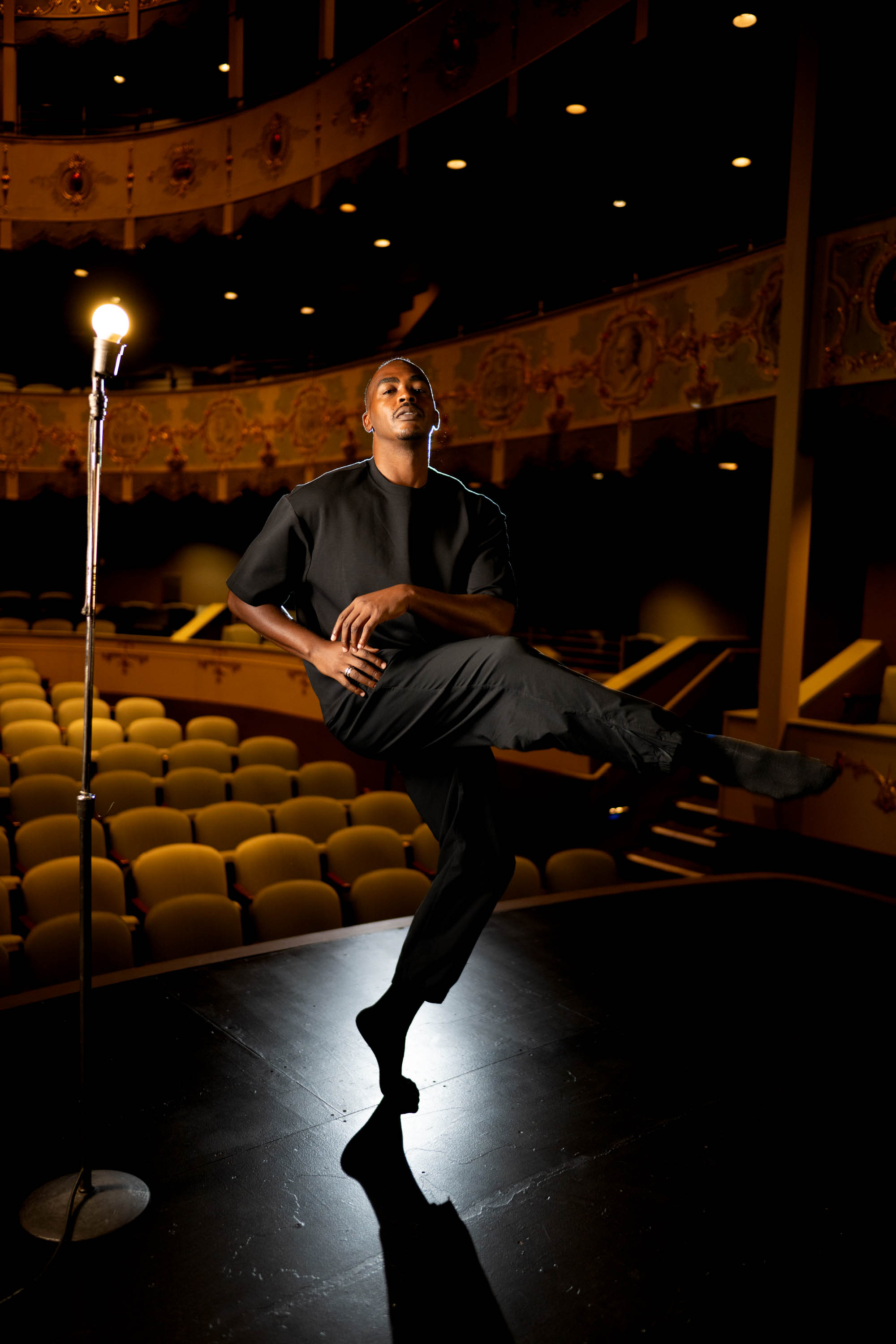
His year spent with the company became a launching pad for Leonard’s professional career—he toured internationally for nine years as a dancer/choreographer for the Bill T. Jones/Arnie Zane Dance Company, was the first Black principal dancer and Master of Ceremonies at The Lido Cabaret and has taught contemporary dance at various institutions around the world, including his alma mater, Booker High. This fall, Leonard returned to Sarasota, where he taught a dance Masterclass at The Ringling and has served as the Historic Asolo Theater’s Artist in Residence, where he will debut a “Work in Process” in February. The Masterclass, intended for higher-level amateur and professional dancers, was born out of a need to support local dancers, to challenge students by exposing them to different techniques and movement patterns.
“It’s important for me as an artist to give artists in the community an opportunity to continue their practice, to continue their artistry and their rigor, in a professional setting where we are building community,” says Leonard. “There are cultural institutions here like The Ringling, Sarasota Contemporary Dance and Westcoast Black Theatre Troupe, which are doing amazing work, and yet there are still dancing artists here that haven’t touched the stage in decades, that haven’t had the chance to perform in years.”
As Leonard has grown, so has Sarasota, transforming into not only a larger city but one with an ever-increasing focus on the arts. Leonard hopes to be a part of that conversation, a factor in Sarasota’s growth not only as a haven for the visual and performing arts, but also as a city where artists come to train, develop and find community. Doing so begins with creating an environment conducive not only to learning but also to creating connections with one another. “I have to create a space where I lead in the way in which I want the community to engage with each other. I’ve been in classes where I’ve felt a huge disconnect from the instructor, and it sets the tone for the rest of the class,” says Leonard. “It’s important for the students to have personal contact with the instructor, to not feel so removed from them.”
The class begins with a warmup, during which the students and Leonard discuss how to embody what he’s asking of them, before moving into phrase work. It is during this time that Leonard aims to build material that the students leave class still thinking about, sprinkling the different styles of contemporary dance that he’s picked up throughout his career into the choreography.
There is a level of emotional maturity, Leonard maintains, that is needed to get the most out of the Masterclass. To be a great dancer is about more than just being technically excellent—it’s about embodying one’s lived experience into their craft. “There is a stark difference between somebody who has an immense amount of technical training and someone who has three-quarters of that, but has what we call ‘something behind the eyes,’” says Leonard. “What I’m interested in is people coming to the class and being committed—not being shy about doing esoteric, weird, crazy things or things that they might find super challenging. You can be just a technician, but I find that you get more bang for your buck, so to speak, when a person comes in with not only a maturity, but a sensitivity they can tap into.”
For Leonard, dance is intrinsic to who he is. It is not only a part of where he came from— “We grew up dancing in the street for the Easter parade”—but a piece of his identity moving forward, as not just a performer, but an educator, choreographer and student himself (Leonard is currently an MFA candidate at Jacksonville University). “The reasons why I danced as a 15-year-old versus why I dance today are different, yet there are still some things that remain the same. That foundation of knowing that art is important and more important now, in these times, remains crucial to me,” says Leonard. “Before, I was dancing to find myself and find where I landed in the world. Now, I’m sharing it—I do it because I want somebody else to find themselves.”